LESSON 3 OF 6
Free Hardanger Course — Lesson Three
A bookmark pattern with buttonhole stitch edging, eyelets, and your first finished piece

Welcome to Lesson 3! This time you'll stitch a Hardanger bookmark — and for the first time, you'll finish the edges and trim away the excess fabric to create a completed piece.
Along the way, you'll learn buttonhole stitch edging (a beautiful way to secure the border) and square eyelets. You'll also practise the Kloster blocks, cutting, needleweaving, and dove's eyes from the earlier lessons.
What You'll Need
Traditional Hardanger is worked in white thread on white fabric, but you don't need to stick to that if you prefer colour!
The Bookmark Pattern
Download and print the chart for this lesson before you begin. It shows the Kloster block layout, the buttonhole edging, cutting lines, and eyelet placement.
Stitching the Kloster Blocks
Start with pearl cotton No. 5 and work the Kloster blocks following the chart. This time the blocks are straight-sided — each satin stitch covers four fabric threads, like the ones you stitched in Lesson 1.
You'll notice arrows on the first few blocks of the chart to guide you on which route to take. When you reach a block that's already been stitched, simply pass your needle through the back of it to reach the next one.
Ignore the Outer Row for Now
The outer row of stitches on the chart shows the buttonhole stitch edging — we'll come back to that. For now, just stitch the Kloster blocks.
Buttonhole Stitch Edging
Before we do any cutting, we'll stitch the buttonhole edge — again with pearl cotton No. 5. This edging secures the fabric threads and creates a lovely decorative border. Follow your chart for placement.
Secure the thread with a waste knot and work from left to right.
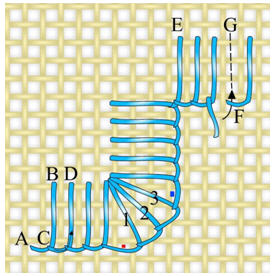
Take the needle up through the fabric at A on the diagram below, and down again at B — one thread to the right and four threads up. Leaving the thread loose, bring the needle up at C within the loop. Pull the thread so the stitch lies comfortably against the fabric. Continue in the same way, taking the needle back down at D.
Turning an Outside Corner
To turn an outside corner, leave one hole free (marked with a red square on the diagram) before working the three numbered stitches on the diagonal. Then miss another hole (marked with a blue square) before carrying on until you reach the next turning point.
You'll use the corner hole five times, so be careful not to pull too tightly — you don't want to make the hole large and unsightly.
Turning an Inside Corner
To work buttonhole stitch around an inside corner, take the needle down at E (on the diagram above). Bring it back up over the thread to form the loop at the corner point.
Joining a New Length of Thread
If you run out of thread while stitching the edging, here's how to join a new length invisibly.
Don't end at a corner! Leave the old thread to one side and secure the new one through the back of the existing stitches. Bring the new thread up one hole to the right of the last stitch (at point F on the diagram). Continue stitching as before.
To complete the join, slip the old thread through the first loop made after the join and take the needle down through the fabric at G to fill in the missing upright stitch. Fasten off at the back of the work.
Stitching the Eyelets

Once the buttonhole edge is complete, work the square eyelets where marked on your chart using the finer No. 8 thread.
Pulling firmly will enlarge the centre hole — that's what gives eyelets their characteristic open look.
To keep things neat, start at point A on the diagram — one hole away from the corner. Take the needle down into the centre hole (B) and up at C to continue around the eyelet.
Cutting the Fabric Threads
Time for cutting again — you're getting practised at this! The chart shows red lines inside the Kloster blocks which mark the threads to cut.
Here's a handy technique: use a needle to make a channel for the scissors. Insert the needle tip before the first fabric thread you need to remove, and bring it back up after the last thread. You'll end up with four threads on the needle.
Pull the needle firmly toward the hole to open the threads a little. This gap will be just big enough to slip the point of the scissors into. Gather the four threads, double-check your count, and snip in one movement.
Use tweezers to gently pull out the cut threads. Have a small tub handy for the discarded threads — they get everywhere otherwise!
Needleweaving and Dove's Eyes
You know the routine by now! Using the finer No. 8 pearl cotton, needleweave the bars — over two threads, under two — until each bar is comfortably filled. Don't squeeze too many stitches in, or the bars will bend. If you need a refresher on needleweaving, pop back to Lesson 1.
After needleweaving three sides of each open square, work half of the fourth bar, then stitch a dove's eye filling. The full dove's eye instructions are in Lesson 2.
Consistency Matters
Try to keep the same number of wraps on each bar and the same tension on each dove's eye. It makes a real difference in the finished piece.
Finishing Your Bookmark
This is the exciting bit — turning your stitching into a real, finished bookmark!
Once all the stitching is complete, it's time to trim away the excess fabric around the edge. Turn your work over so you're cutting from the wrong side — you'll get the scissors closer this way.
Gently push the looped edge of the buttonhole stitches aside while you cut beneath them. Take it slow, don't rush!
Take Your Time
This is the most nerve-wracking part — cutting right next to your finished stitching. Work slowly and carefully. If a small tuft of fabric remains, you can tidy it up with tweezers afterwards.
And there it is — your first fully finished Hardanger piece! If you're not an avid reader yourself, this makes a lovely gift for a friend who'll marvel over your skills.
You Did It!
Look at everything you've learned in this lesson:
Three lessons in — you're really building confidence now!
If you'd like a project to practise on between lessons, take a look at my Hardanger patterns below.
Ready for more Hardanger?
Five charted designs to take you past the lessons, each with step by step instructions and photos.
See the five Hardanger charts →£2.50 each, instant PDF download
Stitchin' Times Newsletter
Stay connected between projects
If you'd like occasional updates from my embroidery room, including new patterns, gentle tips, and little things I think you might enjoy, you're warmly invited to join the Stitchin' Times newsletter.
About Me - Contact Carol - Privacy Policy - Site Map - Testimonials
Please do not copy the content of this site. It is protected by Copyscape.
Copyright © 2006- www.needlework-tips-and-techniques.com All rights reserved