- Home
- Crazy quilting
- Crazy Quilting Ideas
CRAZY QUILTING
Crazy Quilting Ideas That Evolve (With a Real Block Example)
How a butterfly, a thrift-shop blouse, and an old silk tie turned a stalled block into a story.
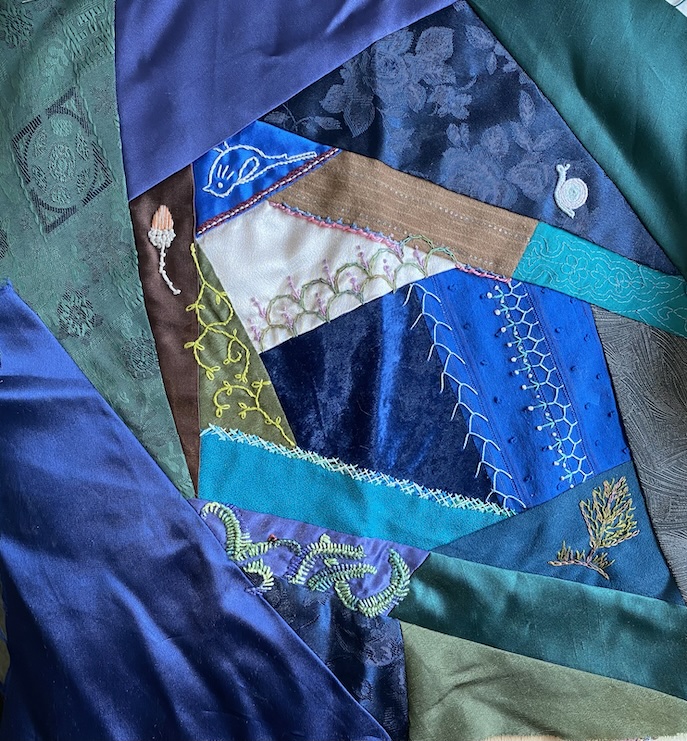
My blue/green block in its early stages, before the ideas started shifting
Other pages featuring this block
How do you embroider letters • Blanket stitch • Feather stitch • Woven picots
Here's something nobody tells you when you start a crazy quilt block: your ideas will change. Sometimes gently, sometimes completely.
You start with one plan, and then the fabrics have opinions. A chance discovery shifts everything. A patch that looked fine yesterday suddenly bothers you. That's not a sign you've done something wrong. It's the creative process doing exactly what it should.
I pieced this block from silk, satin, and various remnants, throwing a cream, brown, ginger, and grey patch in amongst the dark blues and greens. I had no particular theme in mind. I was playing with visual contrast and using up scrap fabrics.
Embroidering the seams and adding a few motifs (a snail, an acorn, a little bird, a tiny tree, some leaves), I kept waiting for the block to come alive. It didn't. So, the partly done block ended up stored in my studio, waiting for better ideas.
Sound familiar? If you've ever set something aside because it wasn't quite working, you're in good company. Sometimes a project needs a rest before you can see what it's asking for.
A Butterfly Changed Everything
I rarely buy new fabrics for my crazy quilt blocks. I prefer recycling and repurposing what I already have. It reduces waste, saves money, and often produces the most interesting results.
Thrift shops are a wonderland for crazy quilters. Pre-owned silk ties and children's outgrown clothes yield beautiful, unexpected patterns and textures. I find them irresistible.
One day I found a blouse covered in butterflies and felt sure it would come in useful. And it did. I cut out one of the butterflies and appliquéd it to my stalled block. Then, of course, it needed a running stitch “flight line,” which I managed to carry over three greenish patches at the bottom right.
You know how things go through your mind, out of the blue? I suddenly saw that the butterfly was flying over green fields.
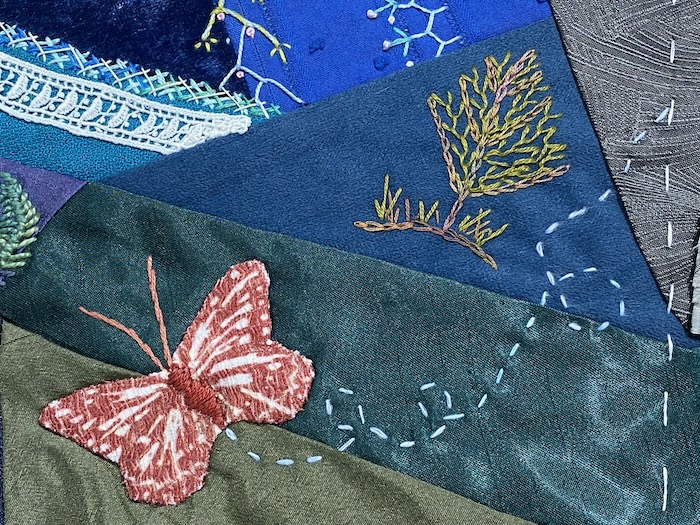
The butterfly that changed the direction of the whole block
That single image, a butterfly over green fields, gave me a story for the block. And once I had a story, I could see what needed to change.
The Patch That Had to Go
With my new “green fields” vision, I looked at the block with fresh eyes. One fabric piece immediately bothered me: the large blue triangular patch at the bottom left.
It was two to three times bigger than the other patches. It dominated the composition and disrupted the balance. Worse, I was at a loss for how to embellish it. It was simply too large and too plain.
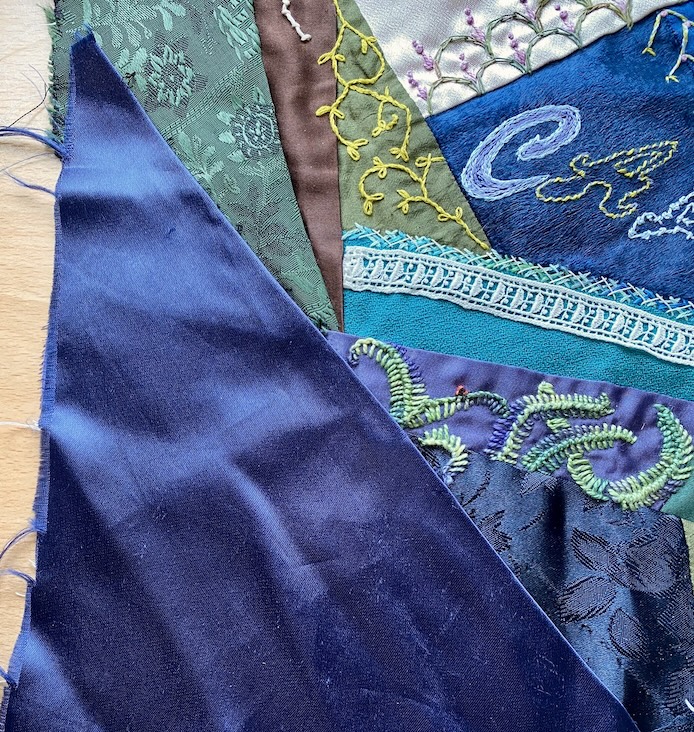
Can you see the problem? That blue triangle was pulling everything off balance
And then the colour issue: if I had fields on the right, it felt odd having solid blue in the opposite corner. Shouldn't that corner also be greens or earth tones, the continuation of land rather than sky?
Unpicking and Replacing
Since the blue triangle had no embroidery or decoration on it, I decided to remove it and replace it with smaller, more appropriately coloured patches.
There was one small concern: my blanket stitch ferns very slightly encroached onto the blue triangle. But I could redo those afterwards, so I carefully unpicked the seam.
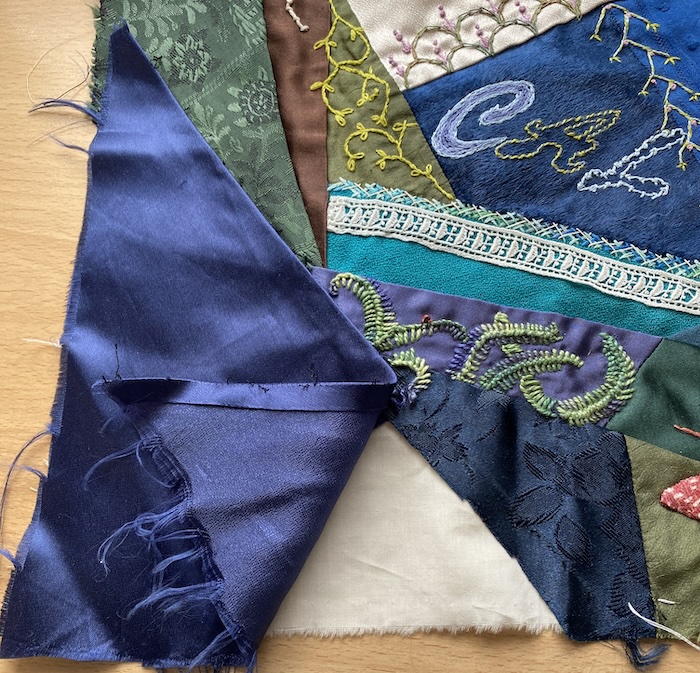
Unpicking, an essential crazy quilting skill
I found two lovely cotton fabrics and seamed them together to make a long strip that would cover some of the calico base.
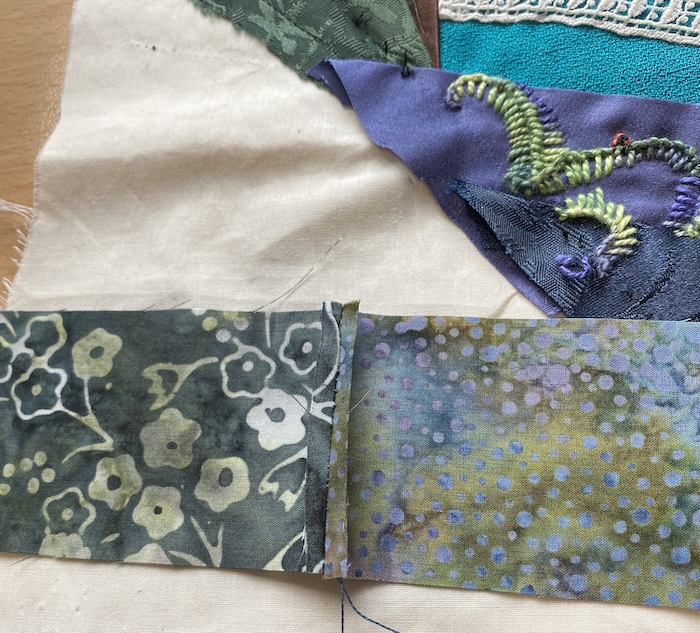
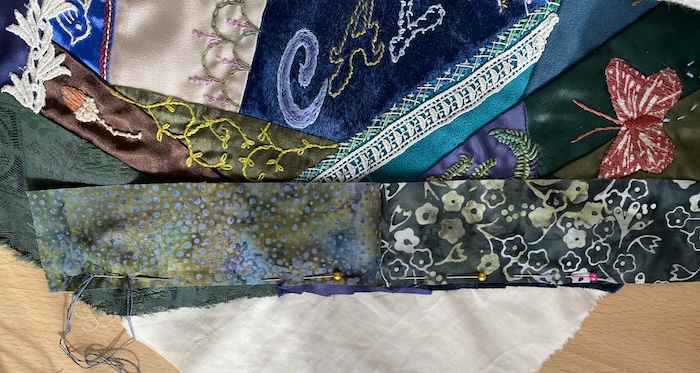
I pinned the strip in place and used backstitch to attach it to the block.
Tying It All Together
The corner needed one more piece of fabric. Wanting to return to silk, I looked through my collection of old ties. And I found exactly the right thing.
I sat and unpicked the tie's stitching, removing a lovely piece of purple silk that had been used to line the point (set aside for a future project, naturally). Using the old seam line as my guide, I pinned and stitched the tie silk in place.
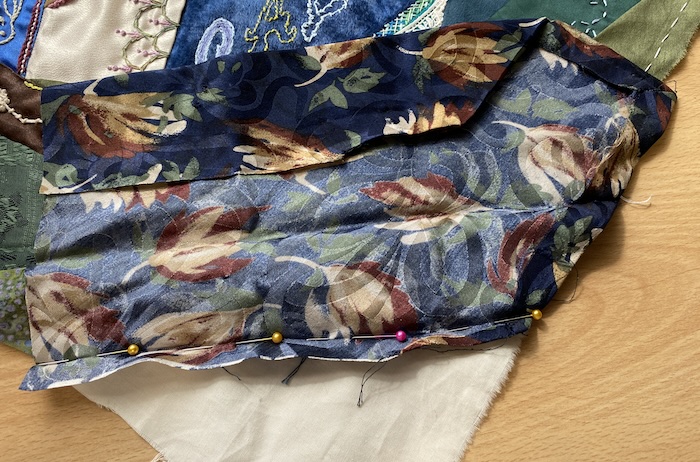
The silk tie fabric slotting into the reworked corner
Look at the Difference
Here's the reworked corner alongside the original. Same block, same position, completely different feeling.
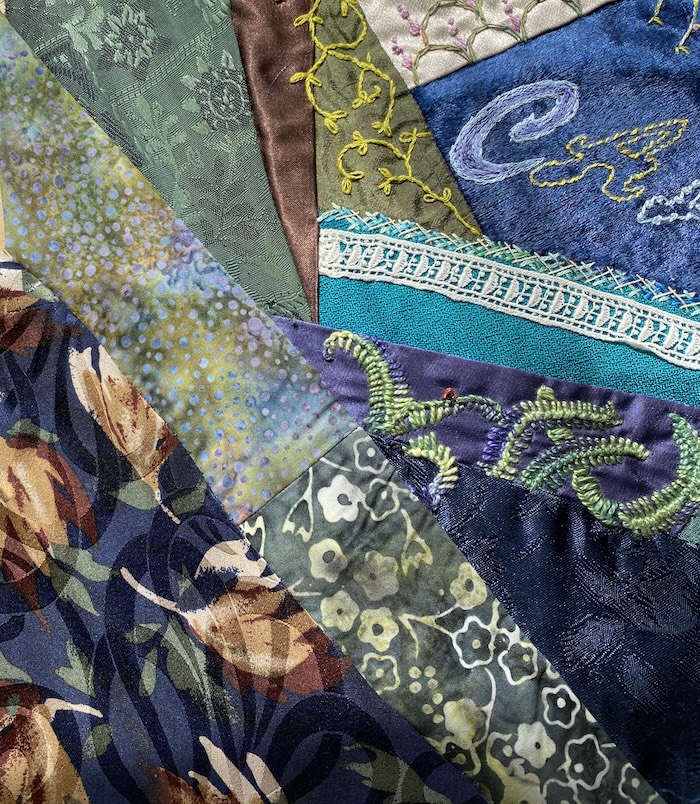
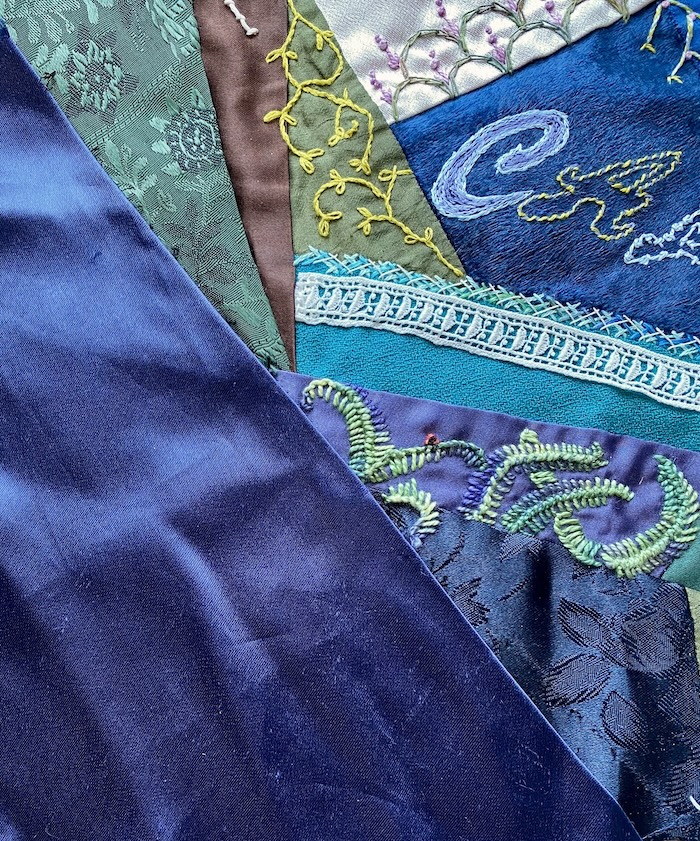
The smaller patches create more visual interest. The colours now support the “green fields” story. And the silk tie adds a richness that the flat blue triangle never had.
Was it worth unpicking and reworking? Absolutely. And it took far less time than I'd spent worrying about it.
Turning a Problem into a Lily Pond
After the rework, I was still left with a small blue patch below the blanket-stitched ferns. Rather than replace that too, I decided to lean into it. A small patch of blue next to greenery? That could be a pond.
I sketched out a lily pad shape using a single strand of floss and double running stitch.
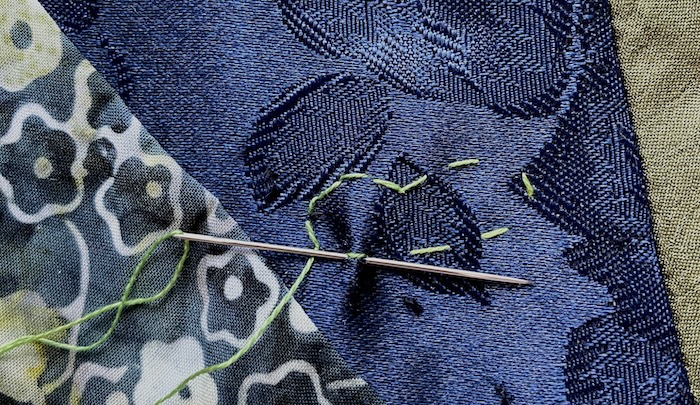
The lily pad outline, just a suggestion of a shape
I chose a variegated pearl cotton and blanket stitch to fill the shape, taking the needle down in the centre each time and angling the stitches outward. Because this patch sits along the edge of the block, I stitched in the hand rather than using an embroidery hoop.
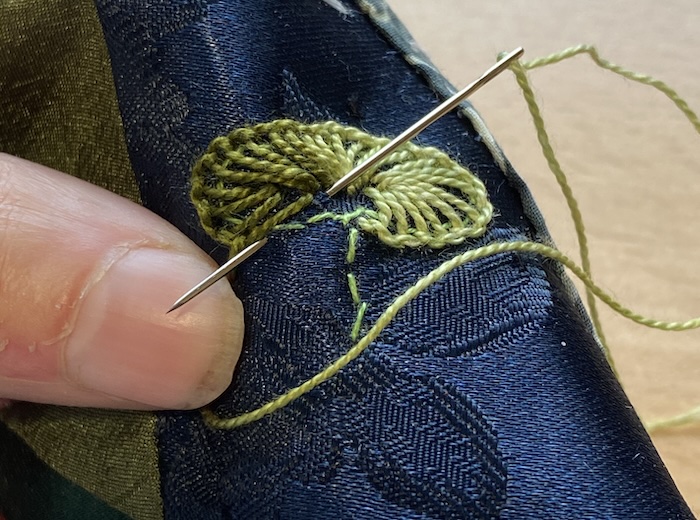
Stitching in the hand: sometimes a hoop would just get in the way
I wasn't aiming for botanical accuracy, just an impression. When I asked my husband what the stitching was meant to represent, he said “water lilies” without hesitation. Good enough for me.
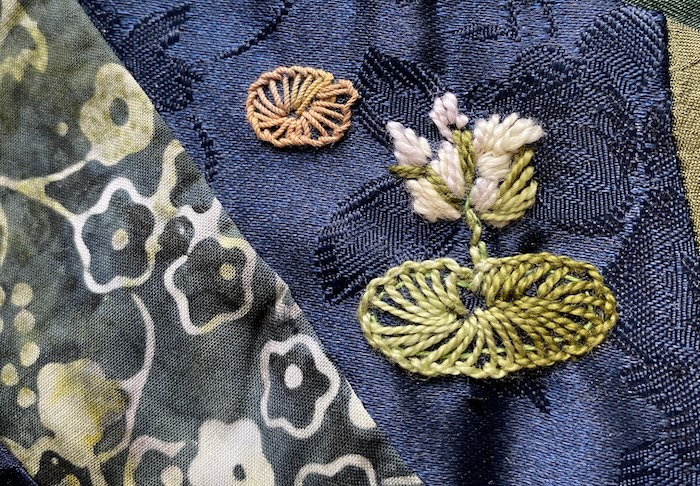
The completed lilies: an impression, not a portrait
I have more ideas for the new corner patches: grasses, reeds, a flower meadow. I'll update this page once the corner is finished. And if you have ideas of your own, I'd love to hear them, you can reach me on the contact page.
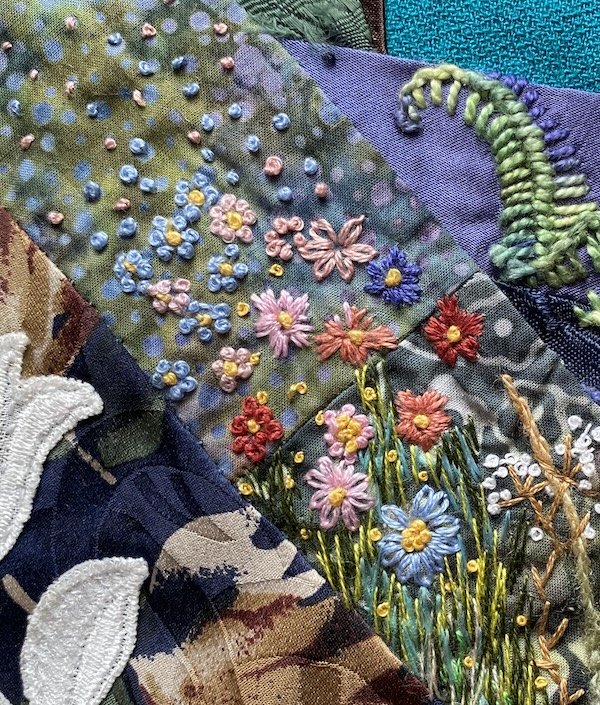
The flower meadow taking shape: forget-me-nots and lavender in French knots, with daisies in lazy daisy stitch.
Let Your Ideas Evolve
This block taught me that crazy quilting ideas don't arrive fully formed. They unfold as you work. A butterfly from a thrift-shop blouse gave the block a story. A willingness to unpick gave it better bones. And a stubborn blue patch became a lily pond.
If your block isn't speaking to you yet, that's not a dead end. It's an invitation to listen more closely.
You might like these
Crazy Quilt Embroidery Stitches: Seam Treatments (List)
Use crazy quilt embroidery stitches for seam treatments: feather, herringbone, chevron, cretan, bullion knots and more—plus motif ideas and materials.
What Is Crazy Quilting? History, Meaning & How to Start
What is crazy quilting? Discover its Victorian history and meaning, then start your first block with our beginner guide, stitches and design ideas.
How to Make a Crazy Quilt Block + Interactive Block Builder
Learn the stitch-and-flip method with step-by-step photos, then design your own crazy quilt block layout with our interactive builder. Download your pattern.

Stitchin' Times Newsletter
Stay connected between projects
If you'd like occasional updates from my embroidery room, including new patterns, gentle tips, and little things I think you might enjoy, you're warmly invited to join the Stitchin' Times newsletter.
About Me - Contact Carol - Privacy Policy - Site Map - Testimonials
Please do not copy the content of this site. It is protected by Copyscape.
Copyright © 2006- www.needlework-tips-and-techniques.com All rights reserved