- Home
- What do I need?
- Embroidery Scissors
Embroidery Supplies
Embroidery Scissors: the tiny tool that stops floss from fraying (and saves your sanity)
How to choose a proper pair, what makes them different from the blunt ones, and how to guard them with your life.
Blunt scissors are why your thread frays. If you have been reaching for the kids' paper scissors or a pair of nail scissors, you already know the alternative: sawing at the floss, opening and closing the blades three times over, and ending up with ragged, uneven ends that won't go through the needle. Someone has told you to get "proper embroidery scissors," and now you want to know what that actually means. That is exactly what this page is for.
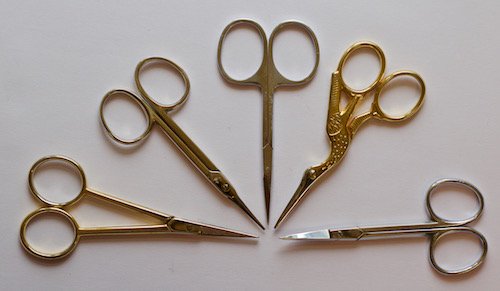
Embroidery scissors have long, slim blades that meet all the way along, sharp right to the tips. The fine points let you see exactly what you are about to cut, with nothing hidden, and they slip into tight spots where bigger scissors cannot reach.
The first time you use a good pair, you prepare for battle from habit, squeeze once, and find the thread already cut. Cleanly. Even when you snip well away from where your fingers are gripping it. It's a small thing that changes how the whole job feels.
Two things are worth knowing before you buy. First, this is not the place to economise. Cheap versions don't stay sharp, so spend a little extra on a good pair and they'll look after you for years. Second, if scissors are hard on your hands or fingers, you are not stuck: a good pair of thread clippers does the same job with a gentle squeeze, and there's a section further down just for you.
One rule keeps a good pair good: never, ever use them on paper, card or wire. Guard them with your life, and keep a larger pair of scissors nearby for those jobs so you're never tempted. Once you've used a good sharp pair, you'll understand why stitchers get so protective of them.
Which to Choose
Types of Embroidery Scissors
Once you start looking, you'll find a whole world of delightful scissors out there. Here are a few you'll run into:
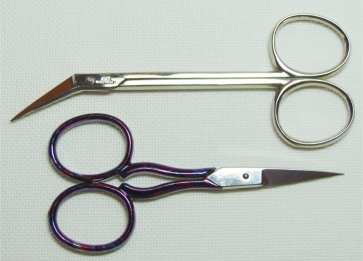
The Angled Pair (A Hardanger Hero!)
See that top pair in the photo above? Those scissors with the funny angled blades are a revelation for cutwork like Hardanger embroidery. The angle lets you keep your hand level while the blades snip away precisely at the fabric threads. Genius!
The Pretty Pair (Because Why Not?)
And let's be honest, there's no rule that says functional tools can't also be beautiful. The pair at the bottom, with their marbled mauve handles, just makes me happy every time I pick them up.
The Quirky Stork Pair
You'll also spot stork-shaped scissors, with the two blades as the beak and the handles as the legs. There's a charming story behind the shape, involving midwives and needlework. Read why embroidery scissors are shaped like storks.
For Sore Hands
What if Tiny Scissors Hate Your Fingers?
If you find the finger holes on traditional embroidery scissors just too small and fiddly, please meet my secret weapon: thread snips.
You don't use finger holes, you just gently squeeze them.
They're fantastic for anyone with larger hands or arthritis, and they work perfectly for both right- and left-handed stitchers. Most come with a little safety cap so you don't accidentally stab yourself rummaging through your project bag.
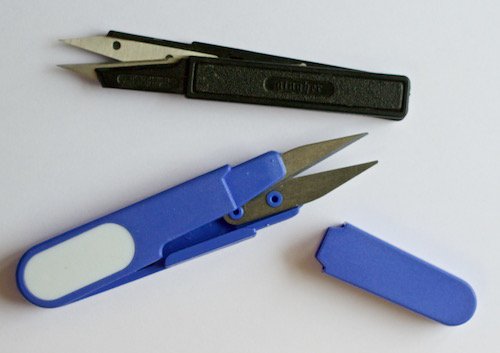
A little tip from my own experience: you get what you pay for here. I've tried the cheap ones, and they go blunt in a flash.
But my Ginghers? Oh, my Ginghers. I've treasured my pair for years, and no one else is allowed to touch them. They are as sharp now as the day I bought them, which is the whole point of spending a little more: a good pair holds its edge, so it really is buy-it-for-life.
And for the travelling stitcher? A Clover Thread Cutter Pendant is a brilliant little gadget. It's a sharp circular blade tucked inside an attractive case you can wear like a necklace. Plenty of stitchers travel with them, but always check the current rules for your airline and airport before packing one in your hand luggage.
Look After Them
The Golden Rule for Happy Scissors
Now that you've found the perfect pair, there is one sacred rule:
Seriously. Cutting paper, wire for stumpwork, or anything that isn't thread will blunt them in a heartbeat. Have a separate "crafty" pair for all that.
Look after a good pair and they'll look after you. Give it a few weeks and you'll wonder how you ever managed without them: cleaner cuts, less wasted thread, and stitching that feels calm instead of a fight.
So guard yours well, and maybe keep them hidden. I once discovered my husband had found my amazing Hardanger scissors very convenient for trimming his beard. Let's just say he only made that mistake once.
Keep Exploring
More to help you kit out your sewing box
Embroidery Supplies
The full guide to what belongs in your sewing box, and where to learn about each piece.
Read more →Hardanger Embroidery
Where those angled scissors earn their keep: the cutwork technique they were made for.
Read more →Hand Embroidery for Beginners
New to all this? Start here and stitch your first piece with confidence.
Read more →Stitchin' Times Newsletter
Stay connected between projects
If you'd like occasional updates from my embroidery room, including new patterns, gentle tips, and little things I think you might enjoy, you're warmly invited to join the Stitchin' Times newsletter.
About Me - Contact Carol - Privacy Policy - Site Map - Testimonials
Please do not copy the content of this site. It is protected by Copyscape.
Copyright © 2006- www.needlework-tips-and-techniques.com All rights reserved