- Home
- Cross Stitch
- Free Assisi Pattern
Embroider History with a Free Assisi Pattern
With this free Assisi embroidery pattern in hand, let's take a journey through the rich history of this traditional Italian needlework, distinguished by its 'reverse' stitching technique.
Originating from the charming Italian village of Assisi, this craft has centuries-old roots and a deep connection to St. Francis, the patron saint of animals.
Its revival in the 19th century by local women led to its flourishing, helped by the establishment of a convent school in 1902.
Now it's your turn to experience the timeless allure of this remarkable embroidery, irrespective of your sewing skills.
 A bronze statue of St Francis in the main Basilica of Assisi. He is depicted as a soldier, realizing his destiny lay in more peaceful ways. - Photo by Cath Andrews
Understanding Assisi Embroidery
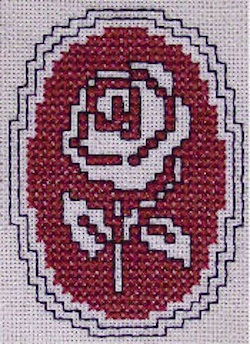
In Assisi embroidery, rather than filling in the design, you embroider the background, leaving the design itself blank.
While traditionally rendered in red or blue with black outlines, the 19th century saw the introduction of other colours such as green or gold.
Often the outlining used double running stitch or backstitch and the solid stitching was generally completed in a form of cross stitch, such as the following varieties...
- Long armed cross stitch
- Montenegrin
- Italian 2-sided cross stitch
Sometimes they used a four-sided stitch pulled work background to give a net like effect, in thread matching in colour to the fabric.
Subjects included mystical beasts, mermaids, nymphs, complex scenes of people and floral motifs, such as my rose design below.
If you like Assisi work you may be interested in checking out my needle-case designs where I blended the idea of assisi work with blackwork and came up with three animal design initially as a magazine commission.
Materials Needed for the Free Pattern

- 8" square of Aida 14 or 28 count evenweave fabric
- Embroidery floss (Red - DMC 498, and black - DMC 310)
- Tapestry needle size 24 or 26
- An embroidery hoop
Getting Started
Begin from the centre of your fabric to ensure the design fits. You can choose to stitch the outlines first for easier counting or start with the cross stitch for a neater finish.
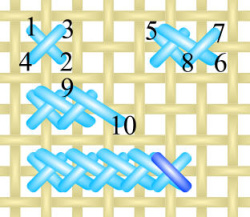
How do I do Long Armed Cross Stitch?
Following the chart above, begin your stitching by creating a basic cross stitch. You'll see numbers 1 through 4 in the diagram below. These numbers guide you on where to insert and bring up your needle through the fabric, creating the first cross stitch in a sequence.
After your initial cross stitch, you'll move on to creating longer stitches. The diagram (below) will show you how to do this, starting at the point marked 5. Pay attention to the length and direction indicated.
It's important to ensure that the shorter arm of your stitches always crosses over in the same direction. This consistency is key to achieving a neat appearance.
As you progress, you'll repeat the sequence of stitches numbered 7 to 8 and then 9 to 10. When you reach the outside edge of the work finish each row with a normal cross stitch (marked in a darker blue in the diagram).
By following these steps, you'll be able to work on your free Assisi pattern effectively, ensuring that your stitches are consistent and your pattern comes out beautifully.
Where can I find more information?
If you are interested in exploring this technique further, a classic book on the subject is Assisi Embroideries by Therese de Dillmont, copies of which are sometimes available from Amazon.
Another rare but wonderful book is Assisi Work & Italian Hemstitching by Camela Testa, which was written about 1927.
A more modern book (1979) is Assisi Embroidery: Technique and 42 Charted Designs from the Dover Needlework Series. This is often available, secondhand, from Amazon.
I'll leave you with more photographs of the village of Assisi, taken by my friend Cath Andrews. Thank you for allowing me to share your pictures, Cath.
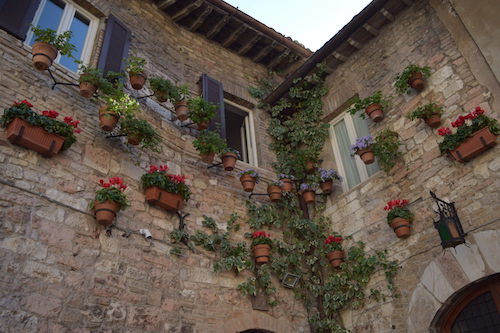
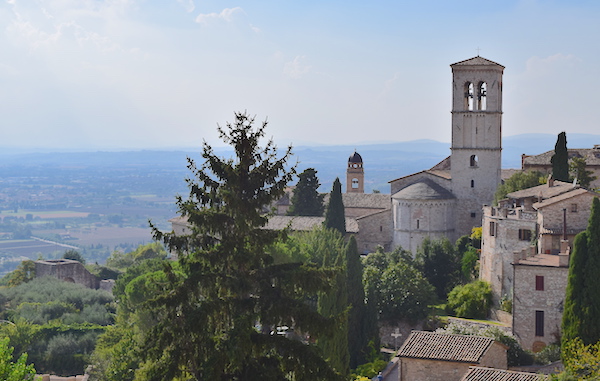
You will find more free patterns here. Enjoy!
You might like these
Waste Canvas Wonders - Personalize Your Wardrobe with Stitching
Take your needlework to the next level with waste canvas: Transform your clothes into one-of-a-kind statement pieces
Rayon Embroidery Thread - From Tangles to Triumphs
Love-hate relationship with rayon embroidery thread? Go from frustration to flawless stitching - discover the secrets and techniques that work
Embroidery and cross stitch videos
Links to my embroidery and cross stitch videos

You might like these
Waste Canvas Wonders - Personalize Your Wardrobe with Stitching
Take your needlework to the next level with waste canvas: Transform your clothes into one-of-a-kind statement pieces
Rayon Embroidery Thread - From Tangles to Triumphs
Love-hate relationship with rayon embroidery thread? Go from frustration to flawless stitching - discover the secrets and techniques that work
Embroidery and cross stitch videos
Links to my embroidery and cross stitch videos
Copyright © Carol Leather - 2006-2024
About Me - Contact Carol - Privacy Policy - Site Map - Testimonials
Please do not copy the content of this site. It is protected by Copyscape.