- Home
- What do I need?
- Laying Tool
- Home
- Cross Stitch
- Laying Tool
What is a laying tool: why do I need one?
Looking for the answer to the question of what a laying tool is and why it is needed for embroidery?
This tool is used to ensure smooth, even stitches on fabric.
It is invaluable for embroiderers, giving a neater appearance to your needlework by helping multiple strands of embroidery floss, rayon or other fibres lay side by side without being twisted. This smoothness allows the light to reflect evenly off the fibres giving a beautiful sheen to your work.
You will find laying tools made from many materials; wood, metal, bone, glass or even plastic. The most important requirement is that they are smooth and free from burs or rough areas.
Basically, they are a long, thin or tapered instrument, sometimes with a handle, that resembles an awl. My favourite is an old mother of pearl handled version with a metal end that I found in an antiques shop. It is beautiful to look at and comfortable to hold.
There is also a version that you can slip onto your finger, which is known as a trolley needle. The danger here is forgetting you are wearing it and poking yourself in the eye!
How to use a laying tool for smooth stitches
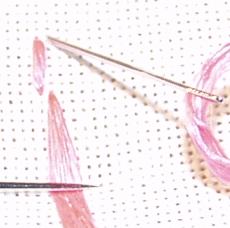
Bring the needle through the fabric and then, holding the tool in your left hand, press it against the floss close to the fabric.
Gently slide the tool towards you a little, spreading the strands flat against the fabric.

Still holding the tool against the thread, push the needle back into the fabric and slowly pull it through until the thread forms a loop around the tool.
Then allow the tool to guide the strands into place before removing it carefully.
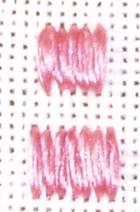
In the photograph, left, I worked the top row using the laying tool. The stitches look smoother and fuller than the unlaid row below.
The fibre used in this sample was Eterna silk and laying the threads enables it to shine evenly. You can see that in the bottom row the light catches the stitches at different angles depending on how they lay.
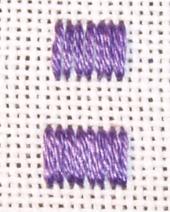
Although not as glossy, stranded embroidery cotton or floss can also benefit from using a laying tool.
In this photograph I used the tool for the bottom row.
You can see how the stitches look fuller and give the appearance of a solid area of stitching, where those in the top row look like separate stitches.
I have used satin stitch in the samples above as it is easier to show the effect it gives. However, you can also use this technique for cross stitch or any other type of embroidery or needlepoint that requires the stitches to lay flat.
You might like these
Rice stitch - an easy needlepoint stitch to learn
Try Rice Stitch - one of the simple needlepoint stitches that you can use to give many different effects
Rhodes stitch instructions and variations
Learn how to stitch rhodes stitch and its variations. Photos and diagrams show how its done and what it looks like in various threads
Needlepoint: An introduction to the traditional craft
Explore the timeless art of needlepoint with our beginner's guide. From materials to techniques, we'll help you get started on your stitching journey.

Copyright © Carol Leather - 2006-2024
About Me - Contact Carol - Privacy Policy - Site Map - Testimonials
Please do not copy the content of this site. It is protected by Copyscape.